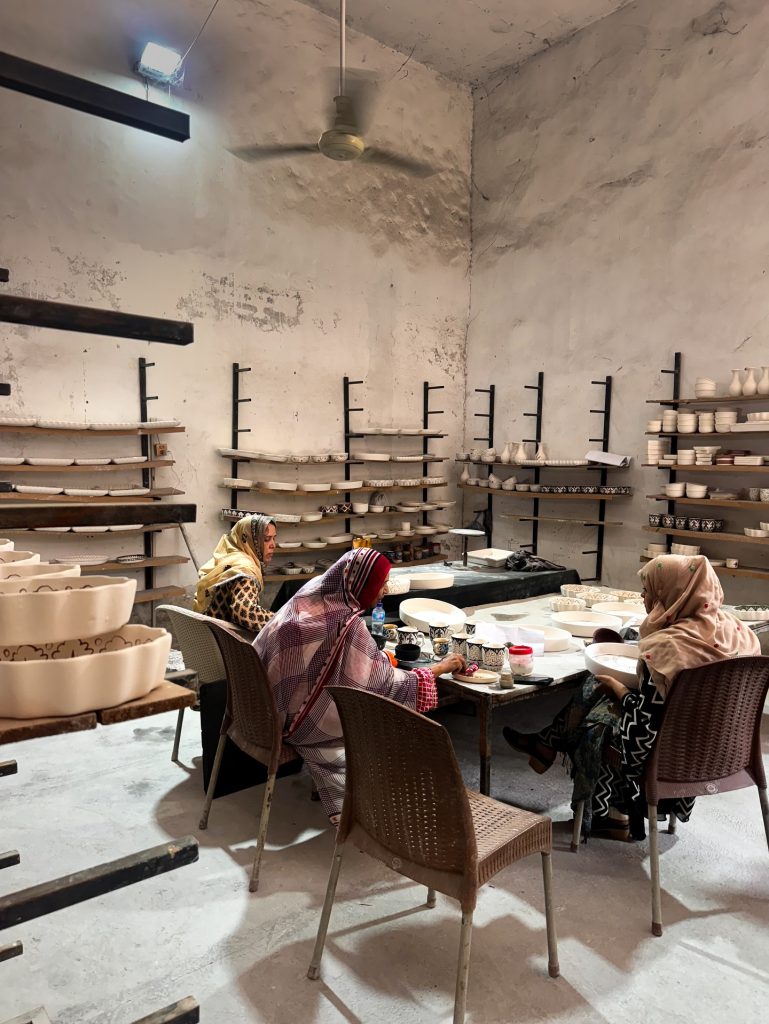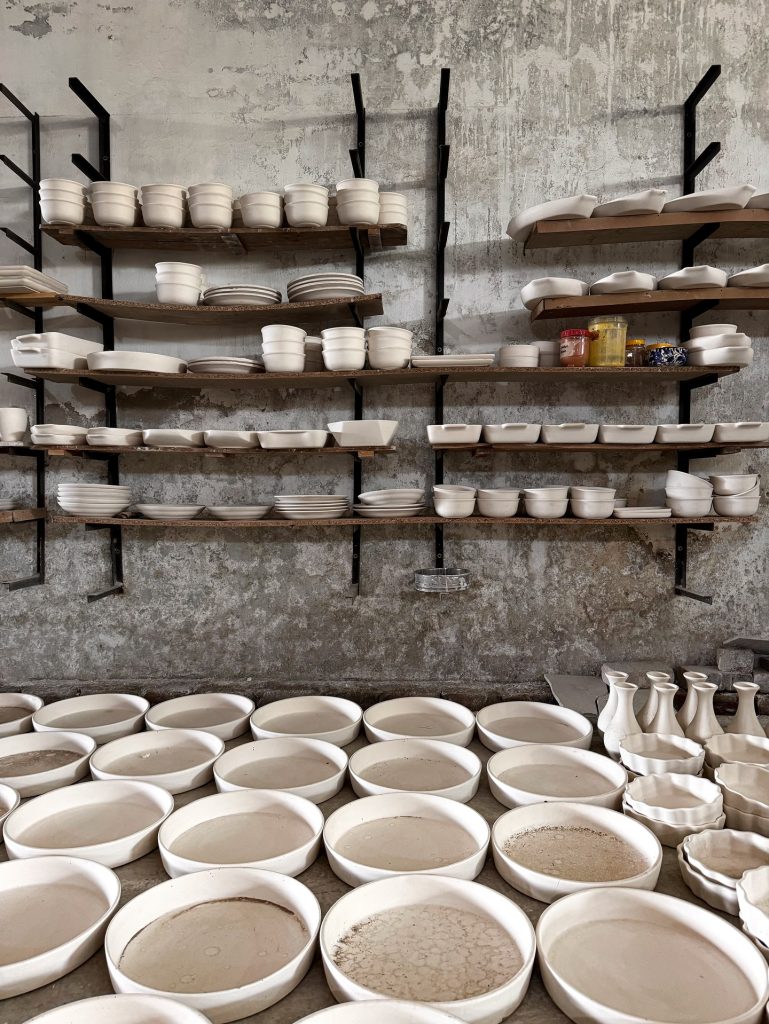

What started in a drawing room by a woman learning the ropes of life has grown into a full-scale studio where every tile, every glaze, and every experiment is shaped by hand and heart. This is not blue pottery as you know it. This is blue pottery, reimagined.
This revival wasn’t taught. It was earned: through broken batches and hearts, failed firings, and countless quiet nights spent testing pigment on leftover shards.
To preserve quality and authenticity, every single step now lives under one roof: from clay sourcing and pigment mixing to the final fire. “We used to rely on others for raw clay,” an artisan shares. “Now we make our own. It’s more work, but we control the quality in every batch.”
This shift wasn’t just logistical, it was philosophical. A way to own the process, to honour the material, and to build something entirely theirs. Because every piece that leaves this studio carries a fingerprint, a decision, a story.
In Raakh’s pigment lab, what began as curiosity has become a full-blown spectrum.
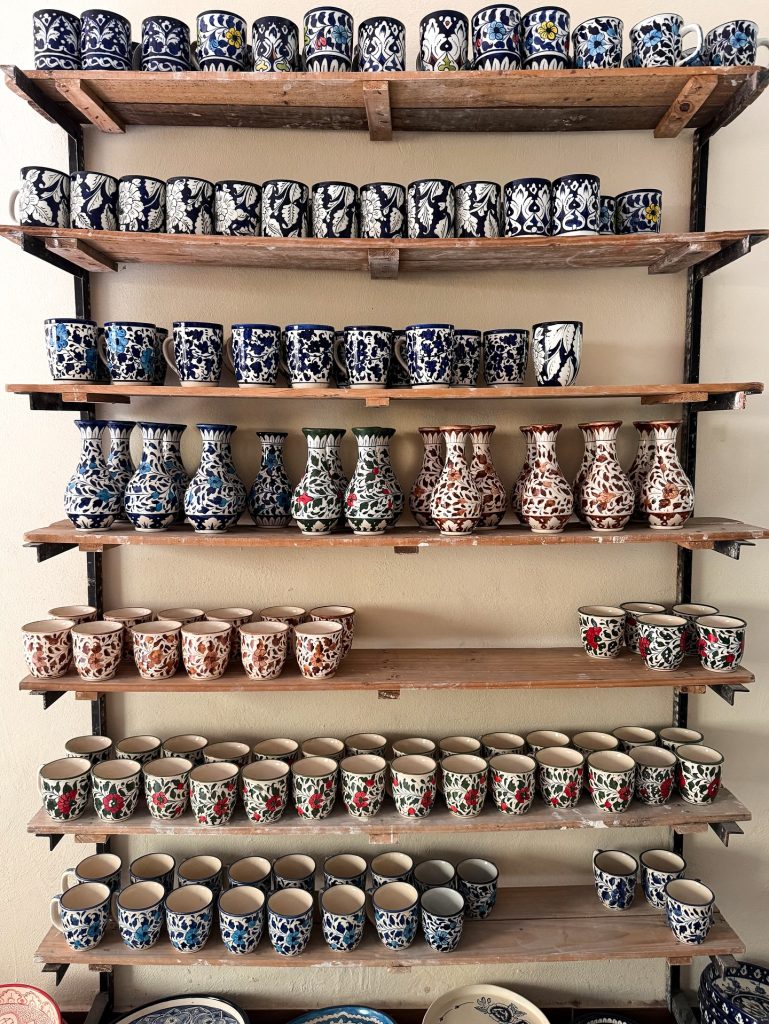
Greens born from metal oxides; terracotta; pink inspired by a late spring morning. After hundreds of iterations, forming Raakh’s new visual vocabulary.
This isn’t just aesthetic experimentation — it’s an act of evolution. A way of asking: why must heritage be frozen in time?
Every pigment is tested, retested, fired, and sometimes lost to the kiln. But when it works, it sings.
This is Kaashigaari, but with new rules. New hues and new stories. By a fraternity of supportive women and men who revere their feminine spirit. Where Raakh enables an inspiring group of unbelievably talented artisans to breathe life into objects that belong on gallery pedestals as much as on kitchen shelves.
And at the heart of it all?
A quiet question asked by a woman at 2am:
Why just blue?
-Segment Videography by @zainahmadphotographs
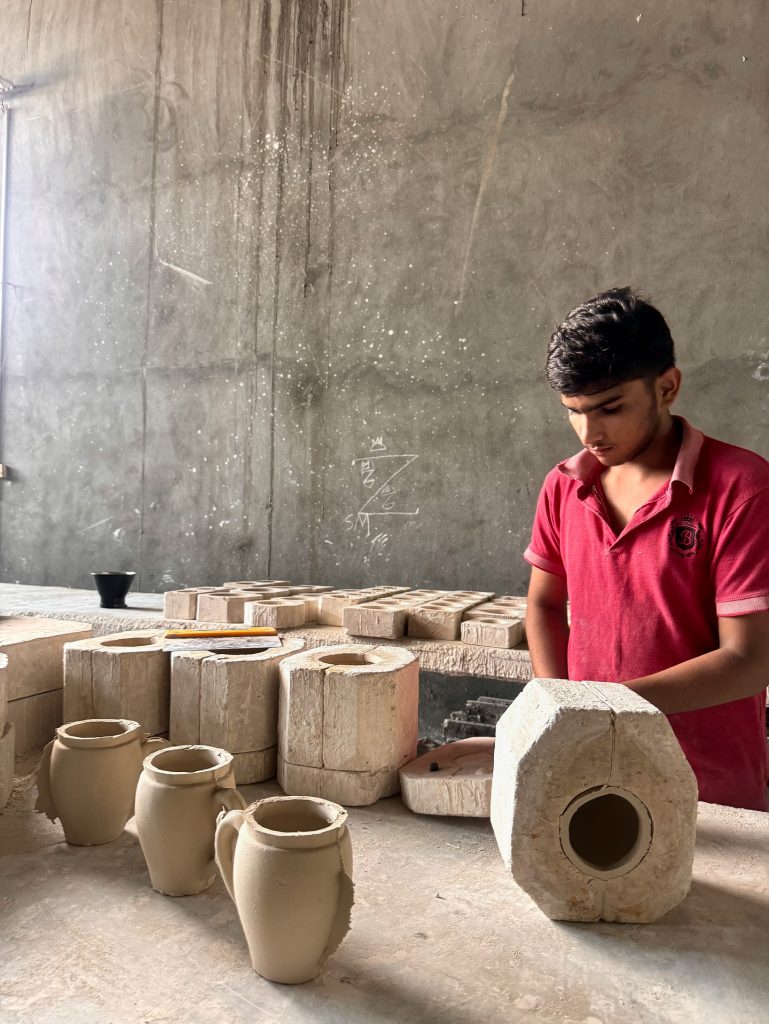


Raakh’s kiln stands for more than just the products it brings to life, rather it stands as a testament to the struggle, faith and bonds that shaped the studio that stands today.
On the surface, these images capture only a familiar scene; walls, tools, a workspace.
But lean in a little closer, and you’ll find the essence of tireless hands, the quiet weight of persistence, and the unseen labour that built a studio of this scale.
It is a story of overcoming daily hurdles, carrying disappointments like unfinished shards, and still returning to the craft.
For Raakh, what began in a small drawing room with a small kiln was never just about clay and fire. The kiln, once 4×5, now 12×18 has come to symbolize Raakh’s own journey.
Raakh’s studio is where faith binds fragments, and fire makes them whole.
Today, this studio stands not merely as a workspace but as a reflection of devotion, resilience, and the boundless creativity that continues to shape it.
One would think that the preservation, innovation, and reimagination of age-old crafts would require those deeply rooted in the field for generations to one day lead its evolution.
But in reality, it is often not those who have long carried the weight of tradition who end up reshaping it.
Kaashigaari, the intricate hand-painted ceramic art of Southern Multan, dating back to the 14th century, rooted in the aesthetic legacies of Persian and Timurid design, is one such craft. Once fading into obscurity, this centuries-old tradition is now experiencing a quiet renaissance in Pakistan.
And Raakh is its phoenix rising from the ashes, to ask a simple question:
Why just “blue”?
A question that changes the scene entirely for Multan’s iconic Blue Pottery.
Once asked, it seems very obvious — as if it must’ve crossed all of our minds. Yet, it took one brilliant mind to chase that question, to glaze it, fire it, bring it to life, and materialise the answer.
And what sparked it?
A 2am thought, drifting through the mind of a girl fresh out of college, navigating the early shifts of adulthood.
Could that have been a quiet moment that planted the seed for what would become Raakh — a marriage of heritage and innovation, tradition and disruption? Or is it the subtle power of the female gaze that lends an entirely new lens?